Most guides to measuring your bra size are too brief to be useful. They tell you to measure two places, plug numbers into a chart, and trust the result. The reality has more nuance — and getting it right is mostly about knowing the small details no one mentions.
This guide walks you through the same method professional fitters use, with the steps explained properly. By the end you'll have two measurements, a calculated size, and a clear sense of whether the result is one to trust or a starting point to refine.
Why measure at home at all?
If a department store fitting is the gold standard, why bother with a tape measure? A few honest reasons.
First, in-person fittings vary wildly in quality. A 2008 study from the University of Portsmouth found that different fitters at the same retailer recommended different sizes for the same person — sometimes by two cup sizes. Many retail fitters are trained in their brand's house method, which often errs toward larger bands and smaller cups (band stretches, cups don't, and bigger bands are easier to keep in stock).
Second, your own measurements remove guesswork from online shopping. If you know your underbust is 30 inches and your bust is 36, you can compare directly to any brand's size chart, in any country. That's a real advantage when good full-bust brands tend to ship from the UK or US.
And third — measuring takes two minutes. Even if you eventually book a fitting, doing it yourself first means you arrive informed.
What you need
- A soft tape measure. The flexible sewing kind, not a metal builder's tape. About £2 if you don't own one.
- A non-padded bra — or no bra. Padding adds inches and skews everything.
- A mirror. Optional but helpful for keeping the tape level.
- Two minutes alone. Don't try to hold a phone against your chest at the same time.
The two measurements
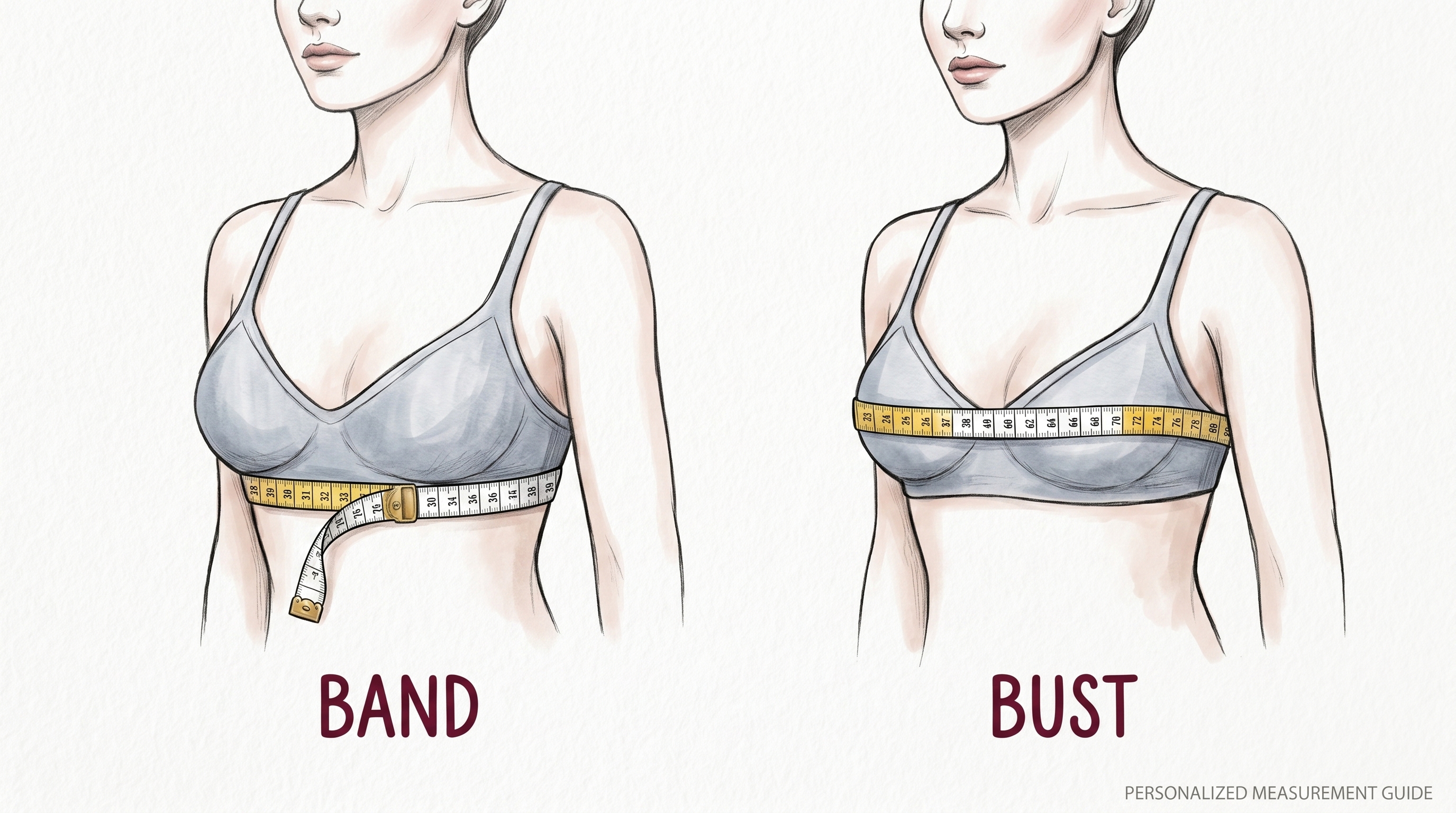
-
Measure your underbust
Wrap the tape directly under your bust, where the band of a bra would sit. Pull it firm — snug enough that it stays put if you let go, but not so tight it digs in. Keep it parallel to the floor all the way around: it's easy for the tape to ride up at the back. A mirror helps. Breathe normally and note the measurement to the nearest half-inch (or full centimetre).
-
Measure your full bust
Wrap the tape around the fullest part of your bust, usually right across the nipples. This time the tape should sit gently — not pulled tight, not drooping. Stand naturally, arms relaxed by your sides. Keep it parallel to the floor here too. Note the measurement.
The maths (or skip it)
Modern bra fitting uses a simple two-step calculation:
- Band size is your underbust measurement, rounded to the nearest even number for US/UK sizing. So 30.5 inches rounds up to 32, and 32 inches stays as 32.
- Cup size is the difference between your bust and underbust measurements. Each inch of difference equals one cup. A 1-inch difference is an A cup; 2 is B; 3 is C; and so on through to D, DD (4 inches), DDD or E (5), F (6) and beyond.
Above DD the systems start to diverge — UK uses E, F, FF, G, GG, while US uses DDD then jumps to G, H, I. We've explained that here if it's relevant to you.
Or just use the calculator
Plug in your two measurements and we'll show you the result in UK, US, and EU sizing simultaneously.
Calculate my sizeCommon mistakes that throw off the result
Wearing a padded bra during measurement
This is the single most common error. A padded bra adds anywhere from half an inch to two inches to your bust measurement, which inflates the cup size by one or two letters. Always measure in something unpadded, or nothing at all.
Holding the tape unevenly
The tape rides up at the back surprisingly easily, especially when you're trying to read it at the front. The result: your underbust looks two inches smaller than it is, and you end up with a band size that's too tight. Glance at yourself sideways in the mirror to check the tape is level.
Inhaling or arching your back
People naturally inflate their chest when they think they're being measured. Take a few normal breaths, then take the reading on a relaxed exhale. Don't suck in; don't push out.
Pulling the bust measurement too tight
The underbust should be firm. The bust measurement should not. If you pull tight across the bust you compress tissue and end up with a cup that's too small. The tape should rest, not grip.
Measuring once
Take each measurement two or three times. If you get the same number twice, trust it. If you get different numbers, take the middle one. This catches small errors before they become a wrong size.
How to know if your result is right
A correctly-sized bra has four signs:
- The band sits level all the way around, not riding up at the back. This is the single biggest indicator. If the band rides up, the band is too loose — go down a band size.
- The cups contain the breast tissue completely, with no spillage at the top, sides, or under the arm. If there's spillage, the cup is too small — go up a cup.
- The centre gore lies flat against your breastbone. If it floats away, the cup is too small or the wires are the wrong shape for you.
- The straps stay put without doing the work. Straps support the bra slightly; the band does the heavy lifting. If straps dig in, the band is too loose.
If your calculated size shows two of these problems, you're likely on the wrong band. Try a sister size — same cup volume, different band — before assuming the calculator was wrong.
The most common fitting mistake isn't getting the cup wrong. It's getting the band wrong, which forces the cup to compensate.
When to remeasure
Bra size changes more than people realise. Re-measure when:
- Your weight changes by more than half a stone (3 kg / 7 lbs).
- You start, stop, or change hormonal birth control.
- You're pregnant or breastfeeding, or have recently stopped.
- You're approaching or going through perimenopause.
- It's been more than a year since you last did it.
- Your current bras have started feeling wrong — even if nothing else has changed, bands stretch over time.
One last thing: the result is a starting point
Your calculated size is the most likely fit — but every brand cuts its bras differently. A 32E in one brand might fit like a 32F in another, and a 32DD in a third. This is normal and not a failure of measurement. The size gets you to the right ballpark; the bra itself either fits or it doesn't.
If your first try-on doesn't quite work, try a sister size before changing brands. If multiple sister sizes fail in the same brand, the brand probably doesn't suit your shape — try another.
The reward for getting this right is a bra that genuinely disappears — no riding up, no digging in, no adjusting through the day. Most people have never owned one. The two minutes with a tape measure is how it starts.
Ready to find your size?
The calculator does the maths and shows you UK, US, and EU sizes at once.
Open the calculator